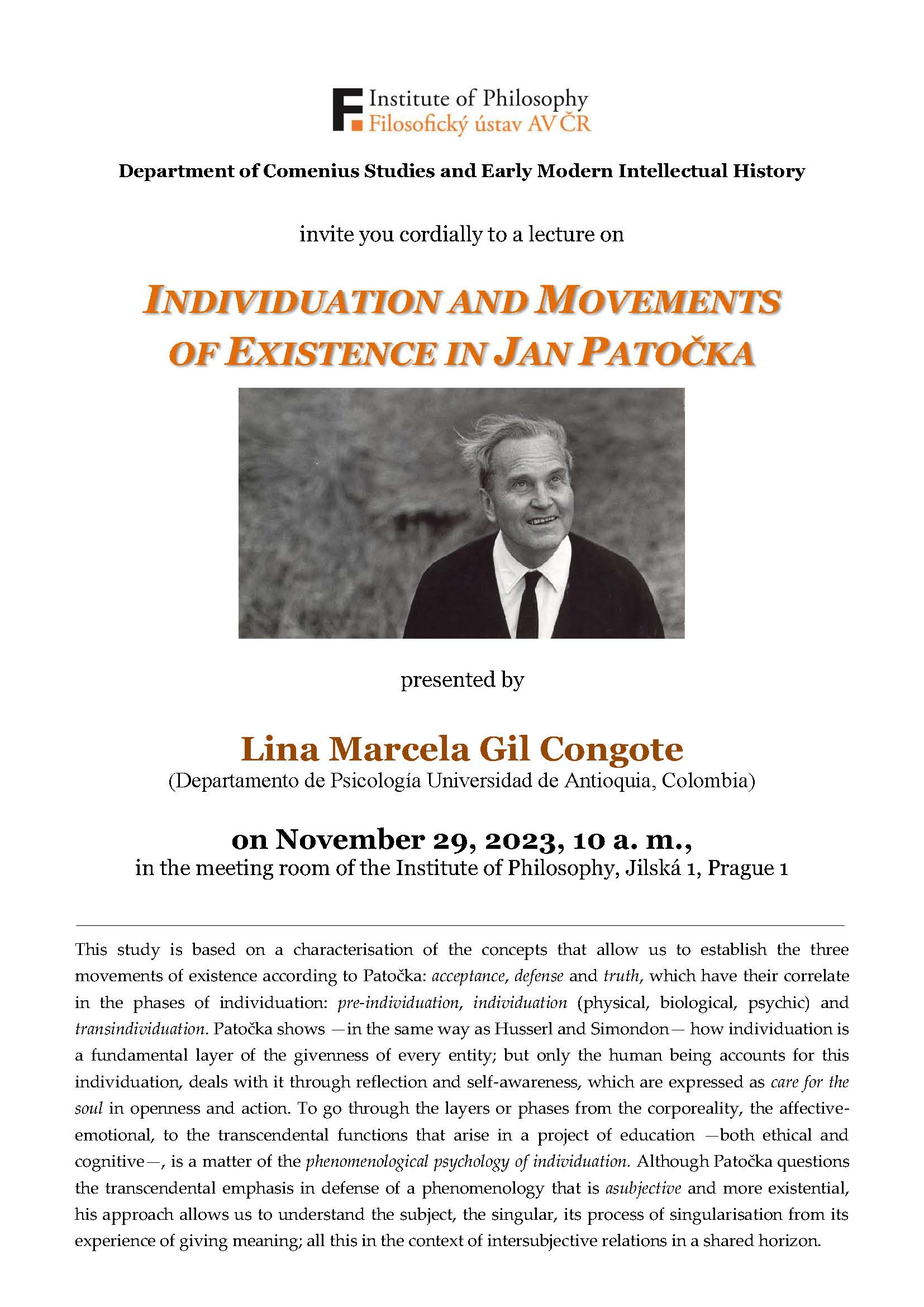

November 29, 2023, 10 a. m., the meeting room of the Institute of Philosophy, Jilská 1, Prague 1
Lina Marcela Gil Congote (Departamento de Psicología Universidad de Antioquia, Colombia),
lecture
This study is based on a characterisation of the concepts that allow us to establish the three movements of existence according to Patočka: acceptance, defense and truth, which have their correlate in the phases of individuation: pre-individuation, individuation (physical, biological, psychic) and transindividuation. Patočka shows —in the same way as Husserl and Simondon— how individuation is a fundamental layer of the givenness of every entity; but only the human being accounts for this individuation, deals with it through reflection and self-awareness, which are expressed as care for the soul in openness and action. To go through the layers or phases from the corporeality, the affective-emotional, to the transcendental functions that arise in a project of education —both ethical and cognitive—, is a matter of the phenomenological psychology of individuation. Although Patočka questions the transcendental emphasis in defense of a phenomenology that is asubjective and more existential, his approach allows us to understand the subject, the singular, its process of singularisation from its experience of giving meaning; all this in the context of intersubjective relations in a shared horizon.
Invitation to download here.